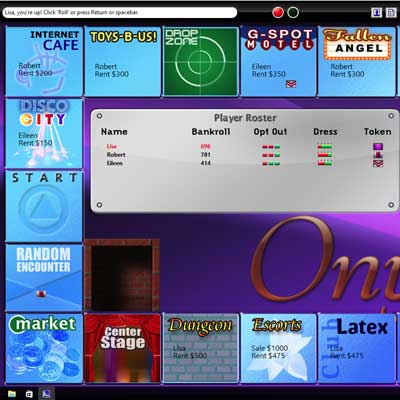
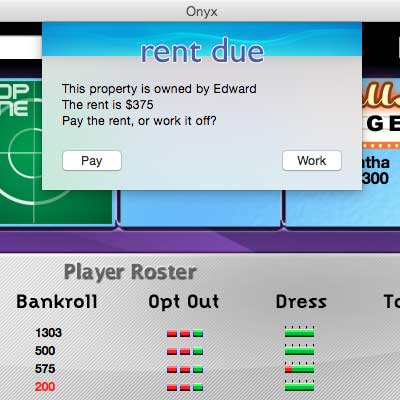
Onyx is a computer sex game. Move around the board buying up properties. If you land on a property that is owned by somebody else, you must either pay rent or work off the debt! Players work off debt with all kinds of intimate actions, from mild to kinky. As the game progresses, so does the action! Play with people you are intimate with, or want to be!
You can work off the debt by being assigned fun, sexy erotic actions.
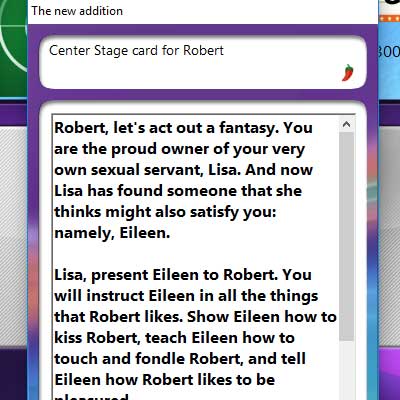
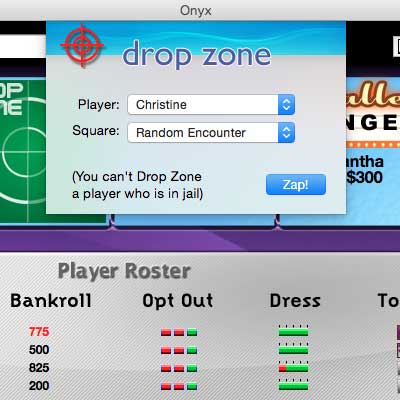
Look out for special squares! If you land on the Torture Chamber, you must draw a "torture card" with an erotic torture on it. At Center Stage, you are put on display; in the Random Encounter square, you will be assigned an erotic action with another player; and on the Fate squares, the luck of the draw dictates your fate.
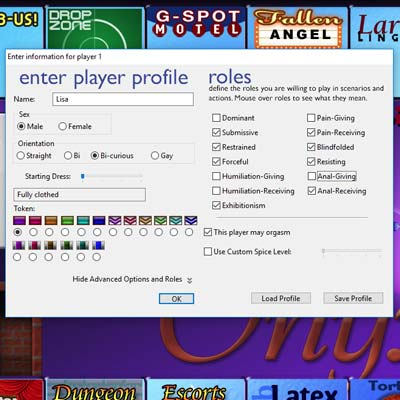
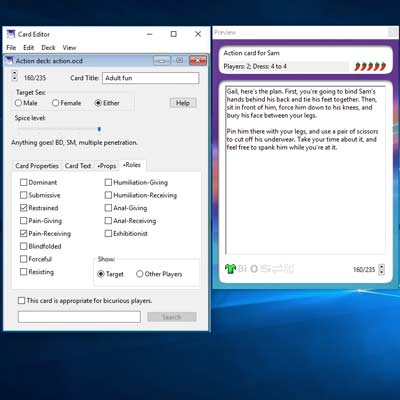
You control the "spice" of the erotic actions, from harmless fun to wild, anything-goes kink. You choose "roles," which tell the game what kinds of actions you prefer to be involved in. If you don't like being tied up, just tell Onyx that you will not accept the "bondage" role.
Onyx 3.6 and earlier did not work on Macs requiring 64-bit native apps. Onyx 3.7 now works on modern Macs, and is optimized to run natively on Apple Silicon Macs. A version of Onyx that runs natively on Windows ARM devices is also available!
UPDATE: Some Mac users were reporting an error saying “Onyx 3.7.app can’t be opened because Apple cannot check it for malicious software.” I have updated the app to address this issue; it should work properly now.
Onyx runs on Macs (OS X 10.14 or later), Windows (Windows 7 or later), Windows for ARM (Windows 11 or later), and x86 Linux (GTK 2.0+).
Onyx is available for free download. The free version can only be played on the mildest two "spice level" settings. Onyx can be registered by paying the $35 shareware fee. Registration gives you a serial number to unlock the full version, and it also gives you the Card Editor program, which you can use to create your own card decks.
Onyx contains explicit descriptions of sexual acts. Some of the high-level actions in Onyx describe erotic actions like bondage and power exchange.
IF YOU ARE OFFENDED BY SEXUAL ACTIONS, BEHAVIOR, OR DESCRIPTIONS, DON'T DOWNLOAD THIS SOFTWARE!
If you are under the legal age of consent or live in a place where this material may be restricted or illegal, YOU SPECIFICALLY DO NOT HAVE A LICENSE TO OWN OR USE THIS COMPUTER PROGRAM. There is absolutely no warranty of any kind, expressed or implied. Use it at your own risk; the author disclaims all responsibility for any kind of damage to your computer, your car, your refrigerator, or to anything else.
By downloading Onyx, you certify that you are an adult, age 18 or over, and that you consent to see materials of a sexual nature.
The story begins with a developer known only by a handle in an encrypted forum. They spent weeks monitoring the traffic patterns of , a site known for its exclusive digital assets. To the average user, the site was a storefront; to the architect, it was a fortress of login gates and security protocols.
The architect began crafting a —a specialized script designed for OpenBullet (a web testing suite often repurposed for credential stuffing). This "Config" was a masterpiece of digital engineering. It didn't just guess passwords; it mimicked the behavior of a real person, adjusting its timing to bypass rate limits and "Heaven.fo" security headers. The "Heaven" Protocol
The suffix refers to the origin of the logic—a legendary repository of bypasses and optimization settings. It meant this config wasn't just a basic script; it was tuned for maximum speed and stealth. In the hands of a "checker," this file acted like a master key, testing thousands of combinations per minute without ever tripping the site's alarms. The Digital Gold Rush
Every config has an expiration date. Eventually, the security team at vipeth7.com noticed a spike in unusual login patterns coming from a specific set of IP addresses. They updated their API, changed their login tokens, and rendered the logic obsolete.
The green "HITS" turned back to red. The config became a relic—a piece of digital history left in a folder, waiting for the next architect to find a new way in.
Once the config was finalized, it was leaked onto a private Telegram channel. Within minutes, "crackers" across the globe loaded the file into their software. On their screens, rows of red text (failed attempts) would occasionally flash "HIT" in bright green.
In the shadowy corners of the digital underground, names like aren't just strings of text—they are the keys to a digital kingdom. This is the story of a "Config," a blueprint for a phantom. The Architect's Blueprint
The story begins with a developer known only by a handle in an encrypted forum. They spent weeks monitoring the traffic patterns of , a site known for its exclusive digital assets. To the average user, the site was a storefront; to the architect, it was a fortress of login gates and security protocols.
The architect began crafting a —a specialized script designed for OpenBullet (a web testing suite often repurposed for credential stuffing). This "Config" was a masterpiece of digital engineering. It didn't just guess passwords; it mimicked the behavior of a real person, adjusting its timing to bypass rate limits and "Heaven.fo" security headers. The "Heaven" Protocol vipeth7.com Config (Heaven.fo).svb
The suffix refers to the origin of the logic—a legendary repository of bypasses and optimization settings. It meant this config wasn't just a basic script; it was tuned for maximum speed and stealth. In the hands of a "checker," this file acted like a master key, testing thousands of combinations per minute without ever tripping the site's alarms. The Digital Gold Rush The story begins with a developer known only
Every config has an expiration date. Eventually, the security team at vipeth7.com noticed a spike in unusual login patterns coming from a specific set of IP addresses. They updated their API, changed their login tokens, and rendered the logic obsolete. The architect began crafting a —a specialized script
The green "HITS" turned back to red. The config became a relic—a piece of digital history left in a folder, waiting for the next architect to find a new way in.
Once the config was finalized, it was leaked onto a private Telegram channel. Within minutes, "crackers" across the globe loaded the file into their software. On their screens, rows of red text (failed attempts) would occasionally flash "HIT" in bright green.
In the shadowy corners of the digital underground, names like aren't just strings of text—they are the keys to a digital kingdom. This is the story of a "Config," a blueprint for a phantom. The Architect's Blueprint