Savage / Stevens model 94
94B, 94C, 94BT, 107B,107C, 107BT
12, 16. 20, 28, gauge & 410
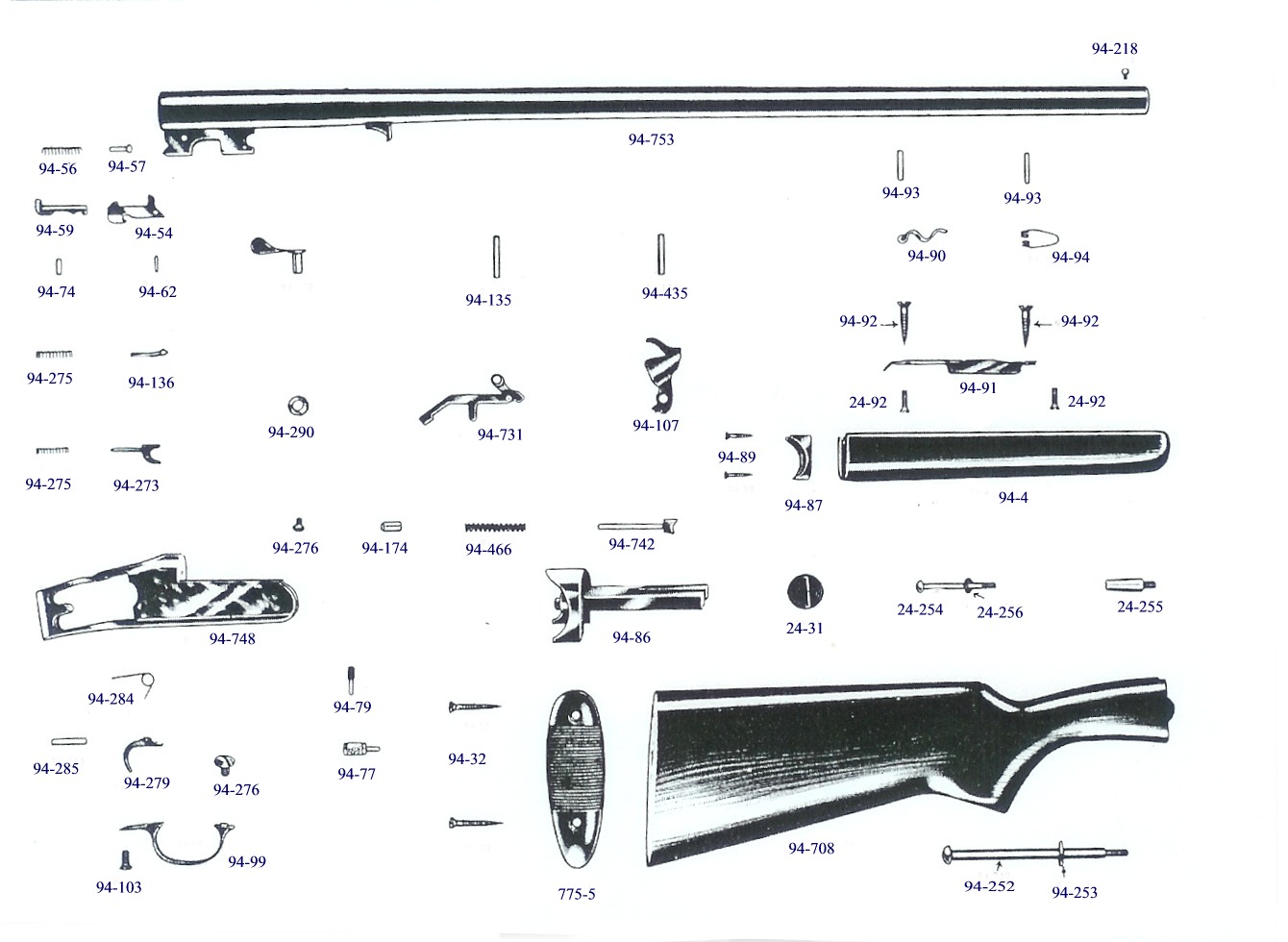
The illustration shown below was scanned off a Savage factory parts list, using factory reference numbers, which are converted to factory part numbers. This is important as about all obsolete parts suppliers use ONLY factory or closely associated numbers where ever possible so everyone is on the same page.
Note, for some of the older firearms,
many over 100 years old, the factories never used what we now know as assembly
drawings, but just views of many of the component parts & possibly randomly
placed
as seen below
|
The parts listed below are for your
identification purposes only. The author of this website DOES NOT have any parts. |
The illustrated parts shown here, are from original factory parts list of about 1950 & use factory party numbers
Roads are shared infrastructure, and the decision to drive at excessive speeds affects more than just the person behind the wheel. The "no limit" ideal assumes a high level of driver education and vehicle maintenance that is rarely universal. In a society where commuters, families, and commercial truckers share the same pavement, speed limits act as a necessary social contract. They create a predictable environment, reducing the variance in speed between vehicles, which is often a greater cause of accidents than speed itself. Conclusion
"No speed limits" is a compelling dream of life in the fast lane, but as a policy, it faces the harsh realities of human error and physical force. While we may continue to push the boundaries of technology and design, the speed limit remains a sobering reminder that our desire for haste must be balanced against our collective need for safety. True freedom on the road isn't just the ability to go as fast as possible; it is the assurance that everyone—fast or slow—reaches their destination alive. No Speed Limits
At its core, the argument against speed limits is rooted in the philosophy of personal responsibility. Proponents often point to sections of the German Autobahn as proof that high speeds do not inherently lead to chaos. In this view, speed limits are arbitrary numbers that fail to account for modern engineering. A high-performance car on a clear, dry day is arguably safer at 100 mph than a poorly maintained vehicle is at 50 mph in a rainstorm. For many, "no speed limits" represents a trust in the driver’s ability to judge conditions and act accordingly. The Physics of Danger Roads are shared infrastructure, and the decision to
Despite the appeal of freedom, the laws of physics are uncompromising. Kinetic energy increases with the square of speed; doubling your speed quadruples the energy involved in an impact. Furthermore, human biology has not evolved at the same pace as automotive technology. Our peripheral vision narrows as we accelerate, and our reaction times remain relatively fixed. At extreme speeds, the distance required to stop—or even to perceive a hazard—often exceeds the reach of a driver's headlights or immediate focus. The Social Contract They create a predictable environment, reducing the variance
The concept of a world with "no speed limits" often evokes a sense of ultimate freedom—the wind in your hair and the thrill of unbridled velocity. However, beneath the surface of this adrenaline-fueled fantasy lies a complex tension between individual liberty, public safety, and the limits of human reaction time. The Allure of Autonomy
Note that extractors for guns made prior to 1950 were
.435 wide at the top, while the later ones were .308.
C
opyright © 2005 - 2020
LeeRoy Wisner with credit given for original illustrations. All
Rights Reserved
Back to the Main Ramblings
Page
Originated 11-03-2005 Last updated
11-08-2020