This section supplements the “LIS-SV”
product manual. The parameters described here are only available if the LIS-SV
is used in an ABULiner control unit.
Overview of the
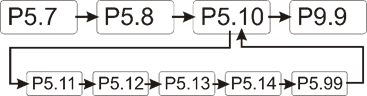
'ABULiner' parameter level
The following parameters can be set in the 'ABULiner'
parameter level of the LIS-SV.
|

|
Danger during setting work!
During setting work on the LIS-SV, monitoring of
the wire rope hoist is switched off. This means the wire rope hoist cannot
be monitored for excess load, among other things. This means the
wire rope hoist cannot be monitored for excess load, among other
things.
This in turn means the load could fall and kill or
injure people!
Do not use the crane for normal work during
setting work, and only lift loads very carefully for test
purposes! |
All LIS-SV parameters which are important for the ABULiner
are combined in a separate parameter level, which is shown as a submenu.
 Move the load hook out of
the limit switch range (up or down).
Move the load hook out of
the limit switch range (up or down).
During parameter setting, the load hook must not be within the
limit switch range.
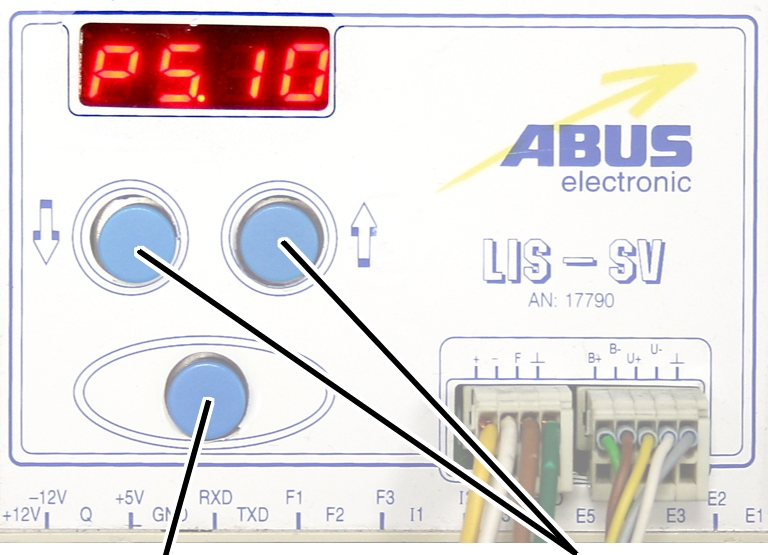
Open the menu of the
LIS-SV. See the documentation “Load indicator system LIS-SV”.
|
|
|
Enter
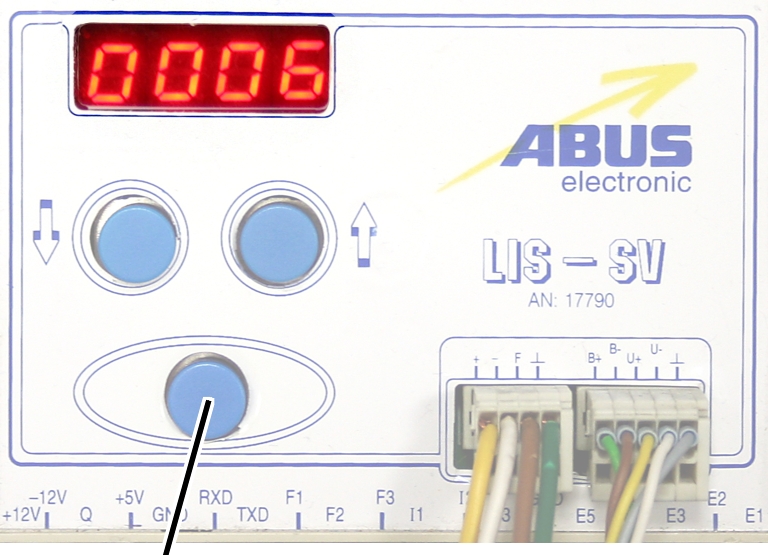
button |
Arrow
buttons |
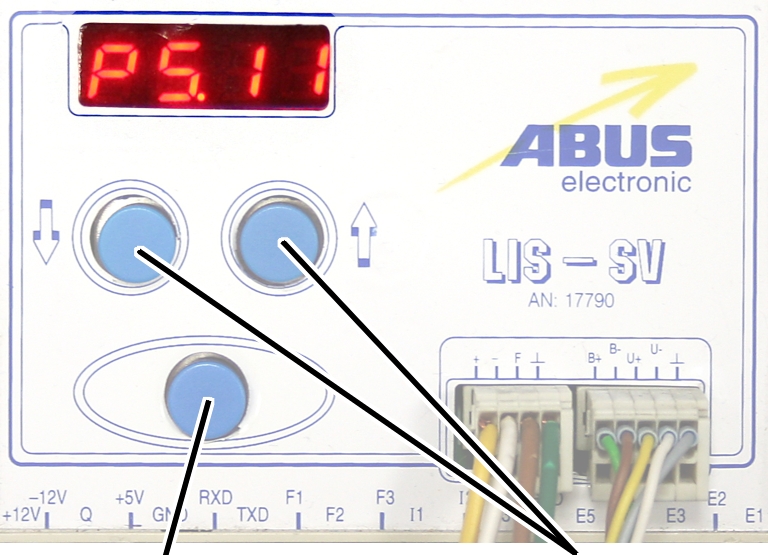
 Select parameter 5.10.
Press ENTER.
● The
'ABULiner' parameter level is activated.
● Parameter
5.11 is displayed.
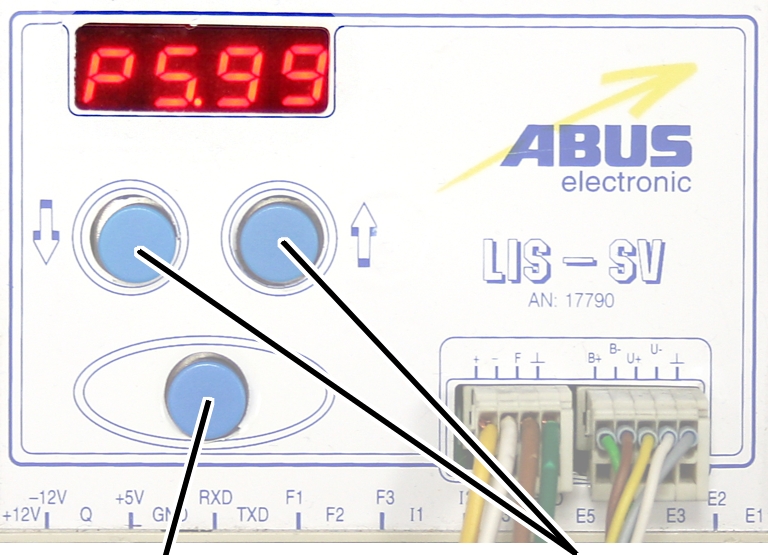
Exiting the
'ABULiner' parameter level
|
|
|
Enter
button |
Arrow
buttons |
Select parameter 5.99.
Press ENTER.
● The
previous parameter level is reactivated.
● Parameter
5.10 is displayed.
The LIS-SV is automatically activated for the ABULiner if a
value is entered for the parameter 5.11.
In the ABULiner mode (a value is set for parameter 5.11):
─ The
LIS-SV can monitor the total load for a maximum of two wire rope hoists.
─ Input F3
(normally used for measuring the load of wire rope hoist 3) now serves in
monitoring the current rotational frequency of the hoist motor.
─ A value
can be entered for parameter 3.0 (maximum load capacity of wire rope hoist 3).
If a value is entered for this, parameter 5.11 cannot be set.
─ This
interlocking thus excludes an incorrect setting.
─ The
load-controlled switching point at output TxD of the LIS-SV cannot be used.
─
Parameter 4.5 (setting for load-controlled switching point) is not available.
In the normal mode (no value is set for parameter 5.11):
─
Operation of the ABULiner Lifting/Lowering unit is not possible.
─ The
LIS-SV can monitor the total load for up to three wire rope hoists.
─ Input F3
serves in measuring the load of a third wire rope hoist.
─ A value
can be entered for parameter 5.11 (gear ratio). If a value is entered for this,
parameter 3.0 cannot be set.
─ This
interlocking thus excludes an incorrect setting.
─ The
load-controlled switching point at output TxD of the LIS-SV can be used.
─
Parameter 4.5 (setting for load-controlled switching point) can be used.
The LIS-SV uses the signal of the encoder and the gear ratio
of the hoisting gear to calculate the hook travel distance, the maximum distance
in the limit switch range and the current rotational frequency of the hoist
motor. The gear ratio must be set on the machine.
|
|
|
Cable
speed |
|
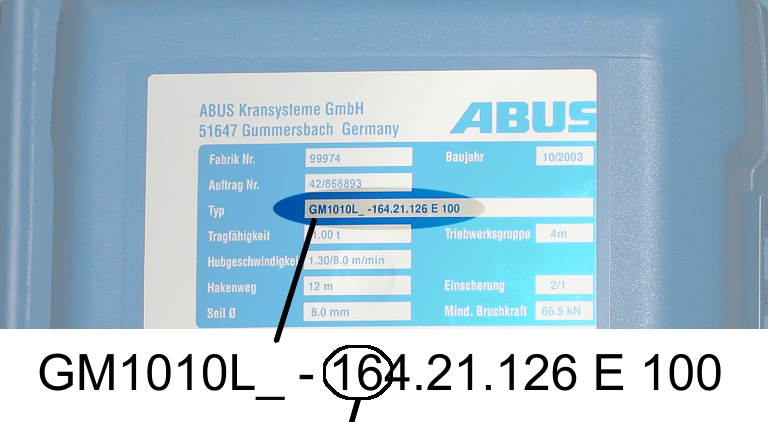
Read off the type
designation at the type plate of the wire rope hoist.
Read off the cable
speed.
From this table, select
the gear ratio that matches the cable speed.
|
|
Cable
speed |
|
Hoist motor GM |
32 m/min at 50 Hz
38 m/min at 60
Hz |
25 m/min at 50 Hz
30 m/min at 60
Hz |
20 m/min at 50 Hz
24 m/min at 60
Hz |
16 m/min at 50 Hz
19 m/min at 60
Hz |
|
800.4 |
50.01 |
63.49 |
77.77 |
98.16 |
|
800.5 |
47.03 |
60.04 |
74.66 |
95.03 |
|
1000.6 |
54.43 |
68.91 |
84.00 |
105.1 |
|
1000.7 |
54.60 |
68.06 |
81.45 |
104.6 |
|
2000.3 |
58.22 |
74.23 |
91.19 |
118.4 |
|
3000.4 |
73.61 |
93.92 |
118.4 |
152.9 |
|
5000.3 |
85.14 |
109.3 |
132.8 |
169.0 |
|
5000.4 |
80.20 |
104.9 |
127.7 |
160.6 |
|
6000.3 |
94.69 |
118.5 |
149.6 |
182.7 |
|
7000.1 |
118.0 |
148.3 |
182.6 |
232.0 |
|
|
|
|
|
|
Table: Gear ratios (numerical values) depending on
hoist motor (lines) and cable speeds (columns) at 50 and 60 Hz.
|
|
|
Enter
button |
Arrow
buttons |
Move the load hook out of
the limit switch range (up or down).
During parameter setting, the load hook must not be within the
limit switch range.
Select parameter 5.11.
Press ENTER.
● The set
value is displayed.
If the value is 0.00, the function is deactivated.
● Hold ENTER
pressed.
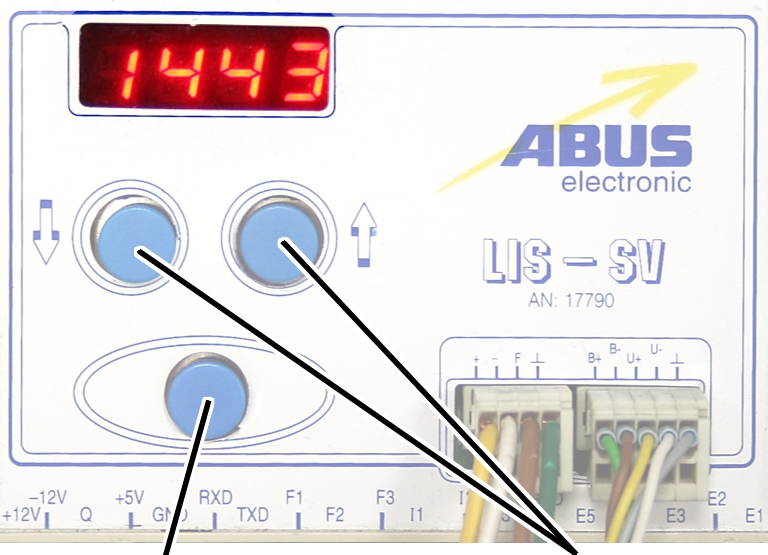
● CODE is
displayed.
Hold ENTER pressed.
|
|
|
Enter
button |
Arrow
buttons |
Enter the code 1443.
Press ENTER briefly.
|
|
|
Enter
button |
Arrow
buttons |
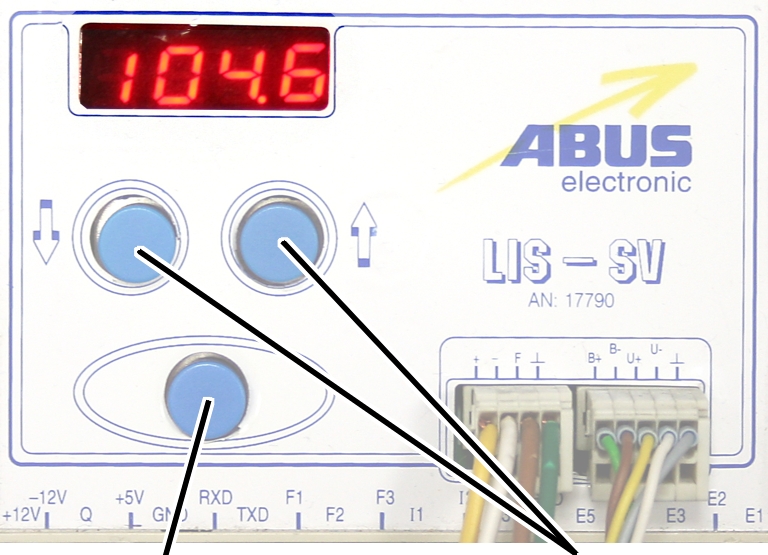
Set the value from the
table.
If the display ‘0.00’ cannot be changed, a value is set in
parameter 3.0. In this case, set the value to zero first.
Press ENTER briefly.
Matures Over 50 Porn -
Modern hits like Grace and Frankie , The White Lotus , and The Kominsky Method have proven that there is a massive appetite for stories that treat aging with nuance, humor, and sexuality. Mature audiences want to see themselves reflected as people with evolving careers, complex romantic lives, and active social agendas. Content creators are finally realizing that "aging" is not a niche interest—it is a universal experience that carries significant narrative weight. The Economic Powerhouse
For decades, the media and entertainment industries operated under a rigid obsession with the 18–49 demographic. The prevailing logic suggested that older consumers were "brand loyal" to a fault and therefore unreachable by new marketing. However, the modern "Mature" audience—those aged 50 and older—is dismantling these stereotypes. Today, this demographic is the wealthiest, most tech-savvy, and most engaged cohort in the media landscape, forcing a radical shift in how content is created, distributed, and marketed. The Digital Migration
Perhaps the most significant evolution is in the nature of the content itself. Historically, characters over 50 were often relegated to tropes: the wise grandparent, the crotchety neighbor, or the person struggling with technological incompetence. matures over 50 porn
The New Prime Time: How Media and Content are Evolving for the Over-50 Demographic
The media landscape is finally catching up to the reality that life does not lose its vibrancy at 50. By moving away from caricatures and embracing the diverse reality of the mature experience, the entertainment industry is tapping into its most loyal and lucrative audience. The "Silver Tsunami" isn't just coming; it’s already here, and it’s changing the channel for the better. Modern hits like Grace and Frankie , The
Looking ahead, the integration of technology will continue to personalize the entertainment experience for this group. Artificial intelligence and algorithmic recommendations are helping mature viewers discover niche content that aligns with their specific interests, from historical documentaries to specialized gaming. Furthermore, the rise of "lifelong learning" platforms and podcasts indicates a desire for content that stimulates the mind as much as it entertains. Conclusion
The image of the over-50 consumer tethered exclusively to linear television and print newspapers is a relic of the past. Recent data shows that "Silver Surfers" are the fastest-growing segment on social media and streaming platforms. From binge-watching series on Netflix to engaging in community discussions on Facebook and YouTube, mature adults have fully embraced the digital revolution. This shift has democratized content consumption; they are no longer passive recipients of what a network programmer dictates, but active participants in the "on-demand" economy. Authenticity Over Stereotypes The Economic Powerhouse For decades, the media and
The pivot toward mature content is driven as much by economics as it is by social progress. The over-50 demographic controls the vast majority of disposable income in developed economies. They have the time to consume long-form content and the financial resources to invest in premium subscriptions, high-end home theater setups, and live entertainment. Advertisers are beginning to follow the money, moving away from youth-centric campaigns to "ageless" marketing that emphasizes vitality and lifestyle over anti-aging desperation. The Future of Mature Media
Only for auxiliary fans
The auxiliary fan of the hoist motor continues to run for
several minutes after the lifting or lowering. This ensures that the hoist motor
is adequately cooled even at slow lifting speeds. The run-on time can be
adjusted.
|
|
|
Enter
button |
Arrow
buttons |
Move the load hook out of
the limit switch range (up or down).
During parameter setting, the load hook must not be within the
limit switch range.
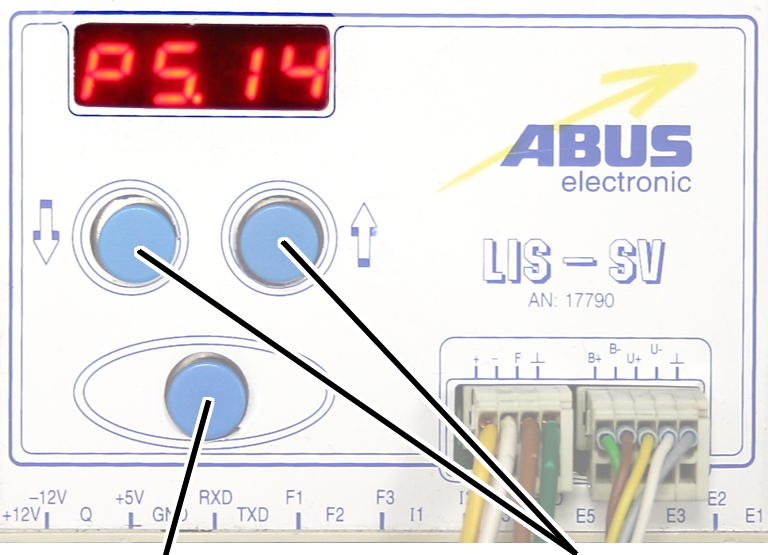
Select parameter 5.14.
Press ENTER.
● The set
value is displayed.
|
|
|
Enter
button |
|
Set the value to between 3
and 10 minutes using the arrow buttons.
Press ENTER.